Showing posts with label Belted Galloway. Show all posts

Sunday, December 18, 2016

Growing Soil With Every Bale of Hay


One of the unexpected benefits I saw last year from feeding hay was that after each bale was more or less eaten by the cattle the remnants of hay left behind ending up being a great spot of pasture this year. As growing soil is a big part of our mission it's a big plus. In the photo above you can see where I drug another bale of hay through the bale from last week, and the soil that's already forming under it. To the right you can see a big green patch of green to the top right, that's where a bale was placed last year. 


Now each bale is placed in an area that isn't growing grass very well, or more simply, on my really crappy areas. It's astounding to watch in the spring as the remnants of that hay end up being a big green patch of pasture. Is it cost effective to add bales of hay simply as a soil amendment? No, but
there's no reason not to place the hay in areas where I'd like to see the soil improved.


I figure somewhere in the next decade I could really improve the worst areas quite a bit with nothing more than being cognizant of where I drop off my winter hay. Not a bad deal.

https://www.instagram.com/snow.farms.tx/

Tuesday, December 13, 2016

The Case for Paddocks


Winter in Texas is so much easier than what I had grown used to in Idaho. That said, things do slow down here with the lack of sunlight and cooler days. Last year I went through 10 round bales of hay with 5 head of cattle, this year we've doubled the herd to 10, but since 4 of them are calves I only bought 18 rounds to try and make it through the winter.

In the interim I'll run the cattle through each paddock for 1-2 days, versus the week or so they cattle get to spend there during the growing months. It's not a real supplement, since the grass is only 6-8 inches tall, but based on their reaction they enjoy the change of pace from hay, and I'm sure there are nutrients available in fresh grass lacking in the baled hay.

Depending on how hard the next two months of winter are I might be able to cycle the cattle through twice. My focus is on taking care of the soil in the paddocks and the main pasture. The main pasture will get turned in to paddocks soon, if the time affords itself.

Monday, November 14, 2016

Why Are You Going With Oreos?


I had one of my former players, who grew up in a ranching family and community ask me this question. I went back through my posts and found I really hadn't put forward a detailed answer. So here it is.

First, much like my friends labeled Deplorables, Libertarians, Constitutionalists, libertarians, anarchists, survivalists, homesteaders, hippies, and everyone else who tries to limit the amount of money that Uncle Sugar picks their pocket for, they serve as a tax hedge here in Texas. You need 4 horses or 4 head of cattle as a minimum to qualify for, and keep, an Ag Exemption on our place. This limits our tax bill and increases money kept in our pocket, which allows that capital to go to work in other places.

Our piece of land is black clay, which to start with is a poor growing medium. Irrigation is too cost prohibitive to make sense here, so we were also looking for drought tolerant cattle that could survive on poor range/pasture/hay. The place had also been over grazed a bit with horses so there wasn't much growing on it for the cattle to "make a living" off of to begin with.

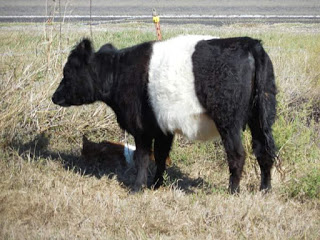
The Galloways are generally thought to be only second to the Texas Longhorn in their ability to not only survive on poor pasture land, but gain weight and thrive on poor range. That proved really true with my two heifers that I purchased at 4 and 6 months old respectively. They received no supplemental feed other than a salt block and a bucket of grain to follow as we take them from paddock to paddock. Those heifers are now cows and are thick and meaty. I trust the three young steers will follow that pattern.

This is a very part time job for me until I retire, but I'm trying to build something that is scalable for after my retirement. The Belted Galloways have to make a profit for the farm with little time or capital input. The Belties are easy on fences, other than my bull who has figured out that he can walk through barb wire strands alone, but won't get close to hotwire. They are easy to manage in paddock shifts, so that's a big plus for us. Land carrying capacity here is around 1 animal unit per acre (I'm at in North Texas) the Oreos are somewhere between .5 and .75 animal units, so the hope is to carry a few more total head than I could with conventional cattle that spreads my risk.

If I carry full size cattle I could probably get away with a bull and 3 cow calf pairs. If I sell at 2 years, we'd be carrying 10 animal units +/-. If I lose a calf, I lose 33% of my potential profit. If, with the smaller Belties I carry a bull, 5 cows, still selling at 2 years I'm carrying 8 - 12 animal units. If I lose a Beltie calf, I've only lost 20% of my profit potential.

Risk management on the homestead is different than on a working ranch and I'm the first to admit that. Just weight-wise 3 two year old large framed cattle, grass fed and finished should have a dressed weight of around 1200 pounds each for around 3,600 pounds total. Where 5 two year old Belties should dress at about 675 pounds each that's only 3,375 pounds, but losing one of each puts the full size net beef at 2,400 pounds where losing one Beltie still nets 2,700 pounds of beef. It's less meat overall, that's true, but it also allows me to put aside an area to graze, not overgrazing during drought years, and focus on our primary mission of growing soil.

Belties are half to three quarters the size of conventional cattle and I'm not nearly as nervous working them by myself as I would be with full size cattle. They're easy birthers, great mothers, and each cow will birth up to 18 calves in a lifetime. They have a compact productive frame, meaning they have a carcass yield of meat usually over 62% for steers, and that equates to cash in the pocket for us.

The last thing is as the slow food movement grows more folks are looking for grass fed, grass finished beef. I live within an hour of more than 7 million people, I only need to find a dozen or so folks that I can sell premium products to, who are also willing to pay a fair price to the producer. Part of the process is in educating our customers that grass fed and finished beef takes longer and thus simply costs more. Providing recipes on how to cook ever cut they pick up from the butcher, and giving them a bit of the experience of the farm.

Finally, I saw commodity farming growing up, it's a tough way to make a living. I'm willing to cater to folks from a marketing and customer service standpoint to make our homestead work.  There is real market demand for this type of beef is real and growing.

Monday, November 7, 2016

Salad Bar Beef


So the calves above are doing well and growing nicely. Thanks to their Scottish roots the rain we've received in the last couple of days has brought nothing but cute frolicking and the calves seem none the worse for wear. Which brings us to the next step, wait, what's the next step? I'm glad you asked.

We grow soil. It's the most important thing that we do, improving the soil so that each year the farm's soil is a little richer, a little deeper, and a little better. We're doing this through paddock shifting our cattle and letting our chickens spread the cattle manure while leaving behind their own. Each year the soil should improve and hopefully we can have a lush pasture year round by year four or five and cease buying hay.

So what are we going to do with the excess fertilizer plants? Out of the three bulls above, our hope is to be sell them to families looking to fill their freezer with grass fed beef. Our plan is to let them graze from 20-24 months before they graduate to the freezer. Right now we think $3.25 a pound hanging weight will be our goal price. When combined with processing fees final price per pound will be around $4 a pound. We're hoping that the steers will be around 600 pounds hanging weight.

If you're interested in trying Belted Galloway grass fed beef send me a message in the comments or snow.farms.tx at gmail.com and we'll get your family on our list.

Thursday, November 3, 2016

My Wife Says I'm a Pessimist...


I am always planning for the worst case scenario. Be it the drive home from work, shopping at Wal-Mart, or expecting apocalyptic pestilence on the Snow Compound. This weekend found us having to pull a calf out of Rosy, the youngest heifer, and that took up most of Sunday afternoon.

While we were focused on that Tito, the smaller of the two Belted Galloways, managed to let her calf escape through the electric paddock. We realized around 6:00 PM that Smore, her calf wasn't doing too well. It was time to move the cattle back onto the main pasture anyway, so I started moving the Belties first, thinking that we could get Tito (so named for her Jerry Curled resemblance to Tito Jackson) and Smore into a pen together.

Tito wasn't having it. Regardless of what we did she wasn't going in the barn. At 6;35 Smore was limp and non-responsive so we made the decision to pull her into the house due to what looked like dehydration. I jetted into town beating Tractor Supply's closing time by a couple of minutes, picked up some colostrum, a dog bottle due to how small Beltie calves are, and a Mister Pibb because it was already a stressful day and having Dr. Pepper was too much to ask!

Andrea went to work getting fluid into the little girl. Strawful by strawful Andrea was getting water into the little calf. I got back and we did the same thing with the colostrum. She wouldn't swallow much, she was cold, and pretty much limp. We put her on the dog bed and wrapped her in a towel and blanket. I fed Smore every hour until she woke me up at 1:30 with a pile of pee and poo and her doing her best ice skater impression on the tile. She wouldn't go back to sleep, so I figured I'd take her out to the barn and see if I could entice her mom into a stall.

No dice on the stall. I begged, I pleaded, I put a bucketful of sweet feed inside the barn to trap her, but she was having none of it. Exasperated, and with Smore starting to fade, I pulled her out of the stall and placed her down by the feed. Momma went nuts, as did the neighbors dogs, and wouldn't stop mooing. Smore perked up, and Momma stood still long enough to let her nurse for a few minutes, before realizing she may not really like this mothering thing after all. They dance with one another for another 15 minutes, Smore trying to nurse, Momma moving every few minutes.

Then Momma just headed to the back 40 with Smore following behind. I left it to Providence to look after the calf. I told Andrea when she woke up that the calf probably wasn't going to make it (about the 10th time I'd predicted death for Smore or Meatloaf, she just hugged me, kissed me, and told me to stop being such a pessimist. I went out after sunrise this morning to find Smore chilling in the back of the pasture and Momma grazing contentedly not too far away.

Only time will tell if Smore is going to make it, but if she lives through the week, the odds increase dramatically.


Tuesday, November 1, 2016

Calf Number 3 in 2016


With first time birthing heifers, you never know what you're going to get, but so far both Belties have had their calves without incident, and both at night strangely enough. We think that this calf is a heifer, and if so the girls have decided on "Smore" as her name. She's Dun colored and really is a good looking calf.

Today she did give us some excitement as she kept escaping the paddock and chilling just out of reach of Momma. She doesn't seem to mind us at all, unlike her half brother from the other Beltie who is skiddish as all get out. Hopefully we can get the electric fence grounded well enough in the dry conditions we're facing to help discourage her from roaming about.

She will be the foundation of our homegrown breeding stock moving forward, provided her genetics look right. The cuteness factor at the Snow Compound has gone up considerably this week!

Tuesday, October 25, 2016

Belted Galloways Versus Their Full Size Brethren


So Andrea and the girls wanted to go the State Fair of Texas this year, and I was lucky enough to get some free tickets at work. To be honest, I'd rather pour hot sauce in my eyes than willingly go to Dallas, much less go to Dallas and wander through huge crowds. Love makes men do stupid things.

After spending the last two years with the Dexters and Belties it was wild walking through the beef cattle exhibits and seeing the yearling steers double the size of our full size cattle. I'm an honest 6 feet tall, barefoot, and after getting used to towering over our cattle it was odd to be looking at the backs of cattle at eye level. It definitely made me more sure that the smaller cattle are right for our little homestead.

I can't imagine, after 2 years of working by myself with the cattle, of working with full size cattle now. If a Beltie steps on your foot, you're hurting, but if a 2000 pound cow steps on you, I can't imagine the damage it will do. The females are easy on fences, the bull on the other hand is not. I can't recommend enough the Belted Galloways for your homestead.

Friday, October 21, 2016

First Calf Born and Bred on the Snow Compound Arrived Today


I noticed that one of the Belties udders was taut yesterday and mentioned to Andrea that I thought the heifer would be calving soon. I went out this morning to feed the hogs and let the chickens out to roam before running into town for jury duty and what do I see? Tito with a calf by her side out by the little barn.

I'm not going to lie, I was giddy. Not normal giddy, think 10 year old, two Red Bulls in on Christmas morning who found a pony under the tree. I tried to get close to Momma and calf, but she didn't want anything to do with me. The belt on the calf was blacklight neon bright white, it's a beautiful animal.

Time will tell what kind of mother she is, hopefully this calf will make it. I'm not going to press my luck for several weeks to determine whether it's a boy or girl, but you'll know when we know. If it's a boy he'll be in the freezer in about two years, and if it's a girl, we'll transition that much quicker to an all Beltie herd.

Tuesday, September 13, 2016

Paddock Shift Rangeland Management


So the paddock on the right had the cattle on it for 4 days, the paddock they're being moved onto on the left hasn't had any cattle on it for just over a month.

It's interesting to watch from one paddock to the next what the cows eat versus what they leave untouched.

The new 1.0 joule, 25 mile Zareba energizer has done a great job in teaching the cattle to stay off the fence. Our herd bull, who has figured out, to my chagrin, that he can pretty much walk through 5 strand barb wire doesn't want anything to do with the electric fence.

This paddock shift has a two fold purpose, first to rest the main pasture for a month going into fall and second to give the Belties and Arial as much good grass as we can before they start calving in October. I can't quantify it, but I expect the manure run off into the swales will also encourage the trees' growth. I'm hoping in the future as we free range the chickens they'll help with spreading the cow paddies.

We've seen a continued improvement of the grasses in the paddocks, and hope that continues on in the future. We'll probably run them through one last time in November, then let the ground rest until March.

I've attached a lot of pictures below of this paddock shift.